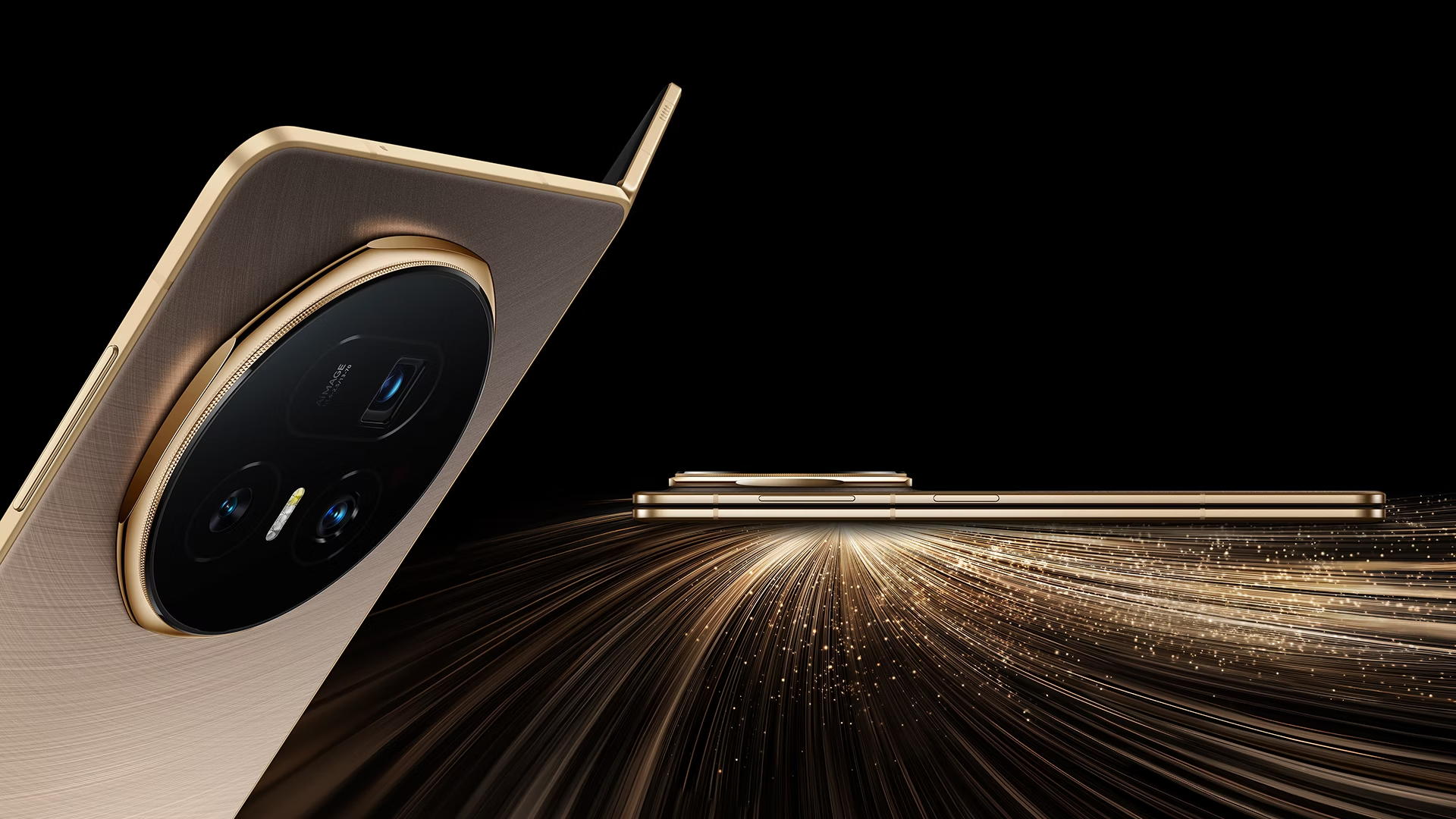
Honor Magic V5
This impossibly slim foldable combines class-leading cameras, exceptional battery life, and flagship performance, though software refinement lags behind its premium hardware execution.
Updated January 28, 2026

The Honor Magic V5 enters a competitive foldable market with audacity, positioning itself as one of the thinnest book-style foldables available while refusing to compromise on core functionality. At just 4.1mm unfolded and 8.8mm folded, this device challenges conventional thinking about what's possible in foldable engineering. Beyond its slender dimensions, the Magic V5 packs a Snapdragon 8 Elite processor, a 5,820mAh silicon-carbon battery, and a triple camera system that genuinely competes with dedicated camera phones. Honor's collaboration with Google on AI features brings practical utility to the software experience, even if the MagicOS interface itself shows its age. With IP58/IP59 dust and water resistance ratings that surpass competitors, seven years of promised software support, and pricing that undercuts Samsung's Galaxy Z Fold 7, the Magic V5 presents a compelling proposition for users seeking alternatives to the Korean giant's foldable dominance.[1][2][3]
Pros
- Exceptional thinness without compromise: At 4.1mm unfolded, the device feels like a regular smartphone when closed while maintaining a 5,820mAh battery and full flagship specifications
- Outstanding camera system for foldables: The 50MP main sensor with OIS, 64MP 3x periscope telephoto, and 50MP ultrawide deliver detailed photos that trade blows with dedicated camera phones
- Industry-leading battery life and charging: Silicon-carbon battery technology enables multi-day usage with 66W wired and 50W wireless charging completing refueling in under 50 minutes
- Superior display technology: Both the 6.43-inch cover and 7.95-inch inner OLED panels reach 5,000 nits peak brightness with 4,320Hz PWM dimming for eye comfort
- Best-in-class ingress protection: IP58/IP59 ratings provide greater dust and water resistance than any competing foldable currently available
Cons
- Software interface lacks polish: MagicOS 9 retains design elements from older builds and feels less cohesive than competing Android skins from Samsung, Vivo, and OnePlus
- Ships with Android 15 instead of 16: Launches one generation behind the latest Android version with no confirmed timeline for the Android 16 update
- Oversized camera module creates usability issues: The prominent octagonal camera island doubles device thickness to 16.5mm and causes wobbling when placed flat on surfaces
- Processing artifacts in low-light photography: Night shots show oversharpening and slow shutter speeds struggle to freeze moving subjects even in good lighting
- Thermal management limitations: The thin form factor restricts cooling capabilities, causing the device to throttle earlier than traditional phones during sustained gaming
The Honor Magic V5 enters a competitive foldable market with audacity, positioning itself as one of the thinnest book-style foldables available while refusing to compromise on core functionality. At just 4.1mm unfolded and 8.8mm folded, this device challenges conventional thinking about what's possible in foldable engineering. Beyond its slender dimensions, the Magic V5 packs a Snapdragon 8 Elite processor, a 5,820mAh silicon-carbon battery, and a triple camera system that genuinely competes with dedicated camera phones. Honor's collaboration with Google on AI features brings practical utility to the software experience, even if the MagicOS interface itself shows its age. With IP58/IP59 dust and water resistance ratings that surpass competitors, seven years of promised software support, and pricing that undercuts Samsung's Galaxy Z Fold 7, the Magic V5 presents a compelling proposition for users seeking alternatives to the Korean giant's foldable dominance.[1][2][3]
Design and Build Quality
The Honor Magic V5 represents a deliberate statement in foldable engineering: thinness need not compromise capability. At 4.1mm when unfolded and 8.8mm folded, the device achieves dimensions that make it indistinguishable from traditional smartphones when closed, addressing one of the fundamental friction points that has historically limited foldable adoption. The achievement becomes more impressive when considering the specifications housed within this frame: a 5,820mAh battery, flagship-tier camera system with periscope telephoto, and Qualcomm's latest Snapdragon 8 Elite processor all coexist without the bulk typically associated with such components.[3][1][2]
The hinge mechanism demonstrates refinement from previous generations, offering smooth articulation without requiring excessive force while maintaining stability at various angles. This unlocked hinge functionality proves particularly useful for photography, enabling hands-free capture scenarios. The crease—often a dealbreaker for foldable skeptics—remains virtually invisible during use, only revealing itself when direct light strikes at specific angles.[1][2]
However, Honor's camera module presents a significant design compromise. The octagonal island protrudes dramatically, effectively doubling the device's thickness to 16.5mm at its thickest point. This creates practical usability issues; placing the Magic V5 flat on tables results in frustrating wobbling that makes unfolded use on desks impractical for many scenarios. While the knurled texture surrounding the camera housing adds premium tactile feedback, the sheer size remains controversial among users who prioritize pocket ability and stable surface placement.[1][2]
The IP58/IP59 ingress protection ratings distinguish the Magic V5 from competitors, providing dust and water resistance that surpasses even Samsung's flagship foldables. This engineering achievement addresses legitimate concerns about foldable durability in real-world conditions, from sudden rain exposure to dusty environments. Honor's NanoCrystal Shield glass protects the cover display, though users must decide whether to maintain or remove the pre-applied screen protector.[1][2]
Display Technology and Visual Experience
Honor's OLED panels establish new benchmarks for foldable displays across multiple dimensions. The 6.43-inch cover screen balances size and usability, offering a wider aspect ratio than Samsung's Galaxy Z Fold 7, which translates to less cramped text and more comfortable one-handed typing. The 7.95-inch inner display, while marginally smaller than some competitors, shows no practical disadvantage in daily use.[1][2]
Both displays achieve 5,000 nits peak brightness, enabling genuine outdoor visibility in direct sunlight—a persistent challenge for previous-generation foldables. The 120Hz LTPO refresh rate delivers fluid scrolling and responsive touch input, adapting dynamically to conserve battery during static content. Color vibrancy and contrast levels exceed category expectations, with reviewers consistently noting the panels' superiority over competing foldables.[3][2]
The implementation of 4,320Hz PWM dimming represents meaningful differentiation for users sensitive to display flicker, a feature absent from Google Pixel and Samsung Galaxy foldables. Honor provides user-adjustable PWM settings alongside additional eye-care features including defocus technology, natural tone adjustment, and hardware-based blue light filtering. The dedicated e-reader mode converts the display to monochrome, transforming the Magic V5 into an unexpectedly capable reading device for extended text consumption.[2]
The inner display's screen protector exhibits less reflectivity than Samsung's implementation, improving visibility during video content with dark scenes—a subtle but appreciated advantage for media consumption. The screen maintains a glass-like tactile quality that feels premium during interaction, though users should note that stylus support requires purchasing Honor's optional pen accessory separately.[1]
Camera System Performance and Image Quality
The Magic V5's triple camera array delivers results that challenge the historical compromise between foldable form factors and photographic capability. The 50MP primary sensor with f/1.6 aperture and optical image stabilization captures detailed images with balanced exposure that favors highlights while maintaining adequate shadow information. In optimal lighting conditions, photos exhibit punchy yet natural color rendition with impressive dynamic range.[1][2]
The 64MP periscope telephoto module with 3x optical zoom emerges as the standout performer, delivering sharper images with less noise than Samsung's Galaxy Z Fold 7 equivalent. Consistent color science across all lenses enables seamless switching between focal lengths without jarring shifts in white balance or saturation—a refinement that demonstrates mature computational photography integration. Even generative AI zoom beyond 10x produces more convincing results than previous Honor implementations, though users should maintain realistic expectations for digital zoom extremes.[1]
The 50MP ultrawide with autofocus handles dual duty as a macro lens, capturing close-up details with satisfying crispness while maintaining color consistency with other sensors. Edge distortion remains minimal, avoiding the stretched appearance that plagues many ultrawide implementations.[1]
Night photography reveals where Honor's algorithmic processing becomes more aggressive. Low-light shots demonstrate effective noise reduction and highlight preservation, but oversharpening artifacts appear more frequently than during daytime shooting. Slow shutter speeds occasionally struggle to freeze moving subjects even in adequate lighting, requiring multiple attempts to capture sharp images of active scenes. These limitations don't diminish the overall camera competence but establish realistic expectations for challenging photographic scenarios.[4][11][1]
Video recording supports 4K at 60fps across all rear cameras with gyroscopic and optical stabilization, producing smooth footage suitable for social sharing and content creation. The 20MP selfie cameras on both displays handle video calls and casual photography adequately, though they don't match the rear camera system's capability.[3]
Performance Characteristics and Thermal Management
The Snapdragon 8 Elite chipset paired with 16GB of RAM delivers flagship-grade responsiveness across daily usage scenarios. Application launches occur instantaneously, multitasking transitions remain fluid, and interface navigation exhibits no perceptible lag. Honor includes an optional High Performance mode that unlocks additional processing headroom, pushing benchmark scores beyond the Galaxy Z Fold 7 in most synthetic tests.[2][1]
Gaming performance proves capable for demanding Play Store titles, maintaining high frame rates during extended sessions. However, the foldable form factor's thermal constraints become apparent during sustained heavy loads. The thin profile limits cooling system capacity, causing the device to reach 47°C during stress testing—warmer than competing foldables though not uncomfortable to hold. Thermal throttling occurs earlier than traditional slab smartphones with identical processors, a predictable tradeoff for the slender dimensions.[8][2][1]
Interestingly, benchmark scores show inconsistency across different testing suites. Geekbench results trail the Vivo X Fold 5 despite identical silicon, while 3DMark's demanding Solar Bay and Steel Nomad Light tests position the Magic V5 ahead of competitors. This variance likely reflects different thermal management strategies and benchmark-specific optimizations rather than fundamental performance deficiencies.[2]
The vibration motor received meaningful upgrades, eliminating the haptic glitching that plagued previous Honor devices. However, system-wide haptic feedback remains less comprehensive than premium competitors, with fewer interaction events triggering tactile responses. Connectivity proved reliable across Wi-Fi, Bluetooth, and cellular bands supported by the international model, though users in certain markets may find limited carrier compatibility.[13][2]
Battery Endurance and Charging Infrastructure
The silicon-carbon battery technology employed in the Magic V5 enables genuine multi-day usage for moderate users. The 5,820mAh capacity (international model) provides approximately 30% more energy than Samsung's Galaxy Z Fold 7, translating to meaningful real-world advantages. Users focusing primarily on the cover display can comfortably extend between charges beyond 48 hours with mixed usage patterns.[8][1][2]
Heavy users leveraging the inner display for gaming and HDR video consumption will drain reserves more rapidly, but battery anxiety rarely becomes a concern even during intensive single-day use. Honor's E2 charging management chip optimizes longevity, and the device promises 1,200 charge cycles while maintaining capacity—a specification that supports the seven-year software update commitment.[3][2]
The 66W wired charging refills the battery in approximately 50 minutes from empty, reaching 50% capacity in just 18 minutes. This rapid refueling capability reduces practical charging time requirements, enabling top-ups during brief breaks rather than requiring overnight charging sessions. The inclusion of 50W wireless charging distinguishes the Magic V5 from competitors, offering convenient charging pad compatibility at speeds that exceed Samsung's wired charging by a factor of two. Five-watt reverse wired charging allows emergency power sharing with accessories or other devices.[3][1][2]
Consumer feedback consistently identifies battery performance as the Magic V5's standout characteristic, with users expressing particular appreciation for the combination of capacity and charging speed. The ability to use the device intensively without constantly monitoring remaining charge represents a genuine quality-of-life improvement over thinner-battery competitors.[8]
Software Experience and Artificial Intelligence Integration
MagicOS 9 based on Android 15 delivers functional utility but reveals aging design elements that diminish the premium hardware experience. The interface retains visual remnants from earlier software generations, creating a less cohesive aesthetic than competing Android skins from Samsung, Vivo, and OnePlus. The default absence of an app drawer results in icon-cluttered home screens, though this can be changed in settings.[1][2]
Honor bundles numerous first-party applications for email, notes, file management, and gallery functions that duplicate Google's default offerings. While some may perceive this as bloat, several Honor applications integrate meaningful AI functionality. Voice recorder transcription achieves impressive accuracy, text proofreading proves useful for communication refinement, and the image editing suite includes helpful tools.[2][1]
The multitasking implementation demonstrates both strengths and frustrations. Honor's Multi-Flex split-screen mode enables three simultaneous applications with two apps bleeding off screen edges to prioritize the active window—a more flexible approach than Samsung's rigid 50:25:25 division. However, the inability to pin the taskbar permanently represents a puzzling omission that competitors have already addressed.[1][2]
Honor's collaboration with Google on AI features yields practical results that exceed most Chinese manufacturers. Real-time call translation, audio-to-text transcription, and image enhancement tools demonstrate genuine utility beyond gimmicky implementations. Only Google's Pixel 10 Pro XL offers a more comprehensive AI suite according to reviewers.[7][2]
The conspicuous absence of Android 16 at launch constitutes a significant disappointment. Shipping with the previous Android generation when competitors deploy the latest release undermines the Magic V5's positioning as a 2025 flagship. Honor's seven-year update commitment remains commendable, but one of those promised updates will merely bring the device current rather than extending support into the future. The company has provided no timeline for Android 16 availability, leaving early adopters uncertain about update cadence.[2]
Long-Term Ownership Considerations
The Magic V5 arrives with meaningful durability certifications that should reassure potential buyers concerned about foldable longevity. The IP58/IP59 ratings provide tangible protection advantages over competitors, while the 1,200-cycle battery specification and seven-year software support suggest Honor engineers designed for extended ownership rather than planned obsolescence.[3][8][1][2]
The device includes a premium leather case in the retail package—a thoughtful inclusion that adds immediate value and protection without requiring separate purchases. Build quality impressions from long-term users indicate the Magic V5 maintains structural integrity and hinge smoothness over extended usage periods. The included accessories and attention to packaging details suggest Honor understands the premium positioning requires commensurate presentation.[12][8]
Thermal management during sustained workloads represents the primary technical concern for long-term performance. While the device never reaches uncomfortable temperatures, users who regularly engage in intensive gaming or video rendering should understand that throttling will occur more aggressively than traditional smartphones. This represents a fundamental tradeoff inherent to ultra-thin foldable designs rather than a Magic V5-specific deficiency.[8][2]
Service and support experiences vary significantly by market, with some regions reporting excellent Honor service networks while others encounter delivery delays and communication challenges. Prospective buyers should research Honor's local presence and support infrastructure before committing to the platform, particularly in markets where the brand maintains limited retail presence.[9]
The seven-year update commitment positions the Magic V5 favorably against most Android competitors beyond Samsung and Google's flagship lines. However, Honor's historical software update cadence hasn't matched the rapid deployment schedules of these established players, creating uncertainty about how quickly major Android versions will arrive following Google's releases. Users prioritizing immediate access to cutting-edge Android features may find this frustrating compared to Pixel or Galaxy alternatives.[8][2]
| Specification | Details |
|---|---|
| Processor | Qualcomm Snapdragon 8 Elite (3nm) 8-core |
| RAM | 12GB or 16GB LPDDR5X |
| Storage | 256GB, 512GB, or 1TB UFS 4.0 |
| Cover Display | 6.43-inch LTPO OLED, 2376×1060, 120Hz, 5000 nits peak |
| Inner Display | 7.95-inch LTPO AMOLED, 2352×2172, 120Hz, 5000 nits peak |
| Main Camera | 50MP f/1.6, OIS, PDAF |
| Telephoto Camera | 64MP f/2.5, 3x optical zoom, OIS |
| Ultrawide Camera | 50MP f/2.0, 122° FOV, autofocus |
| Selfie Cameras | 20MP f/2.2 (cover and inner) |
| Battery | 5,820mAh (International) / 6,100mAh (China) silicon-carbon |
| Charging | 66W wired, 50W wireless, 5W reverse wired |
| Operating System | Android 15, MagicOS 9.0, 7 years updates |
| Durability | IP58/IP59 dust and water resistance |
| Dimensions (Unfolded) | 156.8 × 145.9 × 4.1mm |
| Dimensions (Folded) | 156.8 × 74.3 × 8.8mm |
| Weight | 217g (leather) / 222g (glass) |
| Colors | Black, Ivory White, Dawn Gold, Reddish Brown |
Buy
- You prioritize battery longevity and need a foldable that confidently delivers multi-day usage without requiring portable chargers[1][2]
- Photography quality matters and you want a foldable with genuinely competitive camera hardware, especially the 3x telephoto lens[1][2]
- You operate in challenging environments and require superior water and dust resistance beyond standard foldable protection[1][2]
- You spend extended periods viewing content and need the brightest, most eye-friendly displays available in the foldable category[2]
- You want flagship foldable performance at a lower price point than Samsung's equivalent storage configuration[1][2]
Skip
- You require the most polished, cohesive software experience and value interface refinement over hardware specifications[2]
- You need the absolute latest Android version at launch and want immediate access to cutting-edge OS features[2]
- You frequently use your phone flat on desks or tables and find wobbling from oversized camera modules frustrating[2]
- You primarily shoot action photography or moving subjects in varied lighting conditions where processing consistency matters[1]
- You prefer Samsung's ecosystem integration, One UI customization options, or established warranty and service networks in Western markets[2]
Where to Buy
Critic Reviews
No reviews yet.
User Reviews
No reviews yet.