
TCL QM7K QLED
This mid-range mini-LED TV impresses with extraordinary brightness, deep blacks through Halo Control technology, and 144Hz gaming capabilities that punch well above its competitive positioning.
Updated January 28, 2026
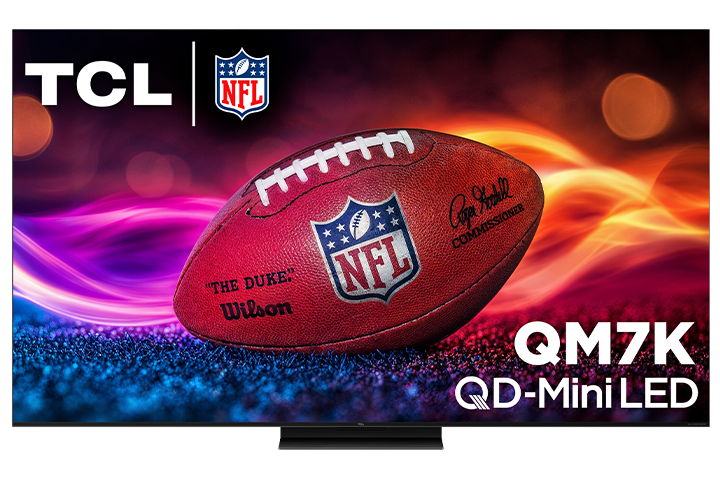
The TCL QM7K QLED represents a compelling mid-range mini-LED television that delivers professional-grade picture quality without premium pricing. Released in 2025, this quantum dot display features up to 2,800 local dimming zones, impressive HDR brightness reaching over 1,700 nits, and native 144Hz refresh rates that cater equally to cinephiles and competitive gamers. The television's standout feature is TCL's proprietary Halo Control technology, which effectively minimizes the blooming artifacts that typically plague mini-LED displays. With Bang & Olufsen-tuned audio, comprehensive HDR format support including Dolby Vision IQ and HDR10+, and Google TV smart platform integration, the QM7K positions itself as a versatile entertainment hub. Available in six sizes from 55 to 115 inches, this television targets consumers seeking near-flagship performance without the associated cost premium.[1][2][3]
Pros
- Exceptional SDR brightness and impressive HDR peak luminance exceeding 1,700 nits makes it suitable for bright viewing environments
- Fantastic contrast ratio with extremely deep blacks maintained even during bright highlight scenes
- Halo Control technology effectively minimizes blooming around bright objects on dark backgrounds
- Native 144Hz refresh rate with up to 288Hz VRR support provides smooth gaming performance
- Bang & Olufsen-tuned audio system delivers significantly better sound quality than typical built-in TV speakers
Cons
- Reflective screen struggles with direct light sources despite good ambient glare handling
- Sub-par HDR color accuracy out of box requires calibration for color-critical viewing
- Minor vignetting visible in screen corners during darker scenes
- Some visible blooming and haloing around subtitles compared to higher-end models
- Limited bass response from built-in speakers despite overall audio improvements
The TCL QM7K QLED represents a compelling mid-range mini-LED television that delivers professional-grade picture quality without premium pricing. Released in 2025, this quantum dot display features up to 2,800 local dimming zones, impressive HDR brightness reaching over 1,700 nits, and native 144Hz refresh rates that cater equally to cinephiles and competitive gamers. The television's standout feature is TCL's proprietary Halo Control technology, which effectively minimizes the blooming artifacts that typically plague mini-LED displays. With Bang & Olufsen-tuned audio, comprehensive HDR format support including Dolby Vision IQ and HDR10+, and Google TV smart platform integration, the QM7K positions itself as a versatile entertainment hub. Available in six sizes from 55 to 115 inches, this television targets consumers seeking near-flagship performance without the associated cost premium.[1][2][3]
Design and Build Quality
The TCL QM7K employs a contemporary minimalist aesthetic that prioritizes screen real estate over decorative elements. The television features slim bezels surrounding the display panel, creating a nearly borderless appearance when viewed head-on . The rear housing utilizes a plastic construction with a grid-like textured pattern that provides adequate structural rigidity despite some flex near the center panel area.[2][1]
A distinctive design element is the height-adjustable center pedestal stand, which allows users to position the display between 2.2 and 3.5 inches above the supporting surface. This adjustability accommodates various soundbar configurations without obstructing screen content . The stand footprint measures 15.47 by 14.49 inches on the 65-inch model, requiring less lateral table space than traditional dual-foot designs. Cable management features include integrated clips and a sliding rear cover on the stand for routing connections discreetly.[1]
All connectivity ports except the power input are positioned on the right side panel when facing the television, angled to allow cables to sit flush against the housing . This side-mounted, recessed port design facilitates cleaner wall-mount installations and improves accessibility . Each HDMI input is clearly labeled with its maximum resolution and refresh rate capability, eliminating guesswork for gaming configurations .
The included remote control features backlighting for low-light operation, dedicated streaming service buttons for Netflix and Prime Video, and an integrated microphone for voice commands. However, the remote lacks a dedicated play/pause button, requiring users to press the directional wheel to access playback controls .[1]
Display Technology and Panel Characteristics
The QM7K utilizes TCL's HVA (High Viewing Angle) panel technology incorporating quantum dot color enhancement. This nano-level engineering adds polyimide structures to liquid crystal molecules, creating butterfly-wing-shaped micro-structures that precisely control light transmission through the liquid crystal layer. The result is an 8000:1 native contrast ratio before local dimming activation, providing an exceptional foundation for the mini-LED backlight system.[5][1]
The quantum dot layer employs upgraded crystalline material with an alloy structure designed for extended service life. TCL's multi-layer wrapping technology combines nanoscale quantum materials with organic compounds to enhance optical characteristics and color attributes. This implementation achieves 96.9% coverage of the DCI-P3 color gamut and 79.2% of the broader BT.2020 color space.[5][1]
The mini-LED backlight system incorporates up to 2,800 individual dimming zones depending on screen size, with the 65-inch model tested featuring 966 zones. TCL's proprietary Halo Control technology manages these zones to minimize blooming effects typically associated with mini-LED displays. Professional testing confirms this technology effectively reduces haloing around bright objects on dark backgrounds, though some visible blooming remains compared to premium models like the QM8K.[3][2][1]
Peak brightness measurements reach 1,733 nits on a 10% window in Filmmaker Mode, with sustained brightness of 1,602 nits. Standard picture mode measurements climb to 2,350 nits peak and 640 nits full-screen brightness . These brightness levels significantly exceed the QM6K predecessor and compete with models from higher price brackets.[3][2][1]
Picture Quality and HDR Performance
The QM7K delivers exceptional picture quality across varied content types, with particular strength in high dynamic range material. The combination of fantastic contrast, high peak brightness, and wide color gamut creates impactful HDR presentations where bright highlights pop against inky blacks. Professional reviewers note that cinematic content with strong cinematography, such as The Batman and Hero, displays detailed yet vibrant imagery benefiting from the comprehensive HDR format support.[7][8][2][1]
The television supports Dolby Vision IQ, HDR10+, HDR10, and HLG formats. Dolby Vision IQ provides particularly useful functionality by adjusting picture characteristics based on ambient room lighting, maintaining visibility even when sunlight enters viewing spaces. This adaptive processing helps compensate for the screen's reflective characteristics in bright environments.[2][1]
However, HDR color accuracy presents a notable weakness. Professional measurements classify the QM7K's HDR pre-calibration accuracy as sub-par, with blues overrepresented in mid-grays and above, resulting in a cold color temperature. Severe color mapping issues affect most colors out of box. Post-calibration measurements improve to "very good" status, but many colors remain off target even after professional adjustment. This suggests color-critical applications require professional calibration for optimal results.[1]
PQ EOTF (Perceptual Quantizer Electro-Optical Transfer Function) tracking is described as great but inconsistent, with content weaving above and below the baseline curve. This means some scenes appear brighter or darker than the content creator intended, though the television generally stays close to target values. The panel implements appropriate roll-off near peak brightness for content mastered at 4000 nits to maintain highlight detail.[1]
SDR (Standard Dynamic Range) performance proves more consistent and accurate. Pre-calibration SDR accuracy rates as great, with only slight color temperature coolness and minimal gamma issues. Post-calibration achieves fantastic accuracy with near-perfect white balance, exact color temperature targeting, and vastly improved color accuracy.[1]
Gaming Performance and Responsiveness
The QM7K positions itself as a gaming-focused television with comprehensive feature support for current-generation consoles and PC gaming [3][8]. Two HDMI 2.1 ports support 4K resolution at 144Hz refresh rate, with variable refresh rate capabilities extending to 288Hz at 1080p resolution on most models [1][5]. The 55-inch variant caps VRR at 240Hz [1]. These specifications accommodate PlayStation 5, Xbox Series X|S, and high-end gaming PCs [1].
Input lag measurements register at 13.1ms in Game Master mode, which TCL's equivalent to dedicated gaming picture presets. While this figure exceeds measurements from Samsung and LG premium gaming televisions, it remains imperceptible during gameplay and provides immediate responsiveness
The television supports all three VRR technologies
HDMI Forum VRR, AMD FreeSync Premium Pro, and the technology is compatible with both major console platforms.[1]
Pixel response time characteristics rate as decent for LED technology, with faster transitions at 144Hz than 120Hz operation. Professional measurements indicate noticeable motion blur exists compared to OLED displays, particularly at lower refresh rates, but performance meets or exceeds expectations for LED panel technology. Some overshoot occurs during transitions from dark to bright shades, creating inverse ghosting artifacts, though this remains less pronounced than many competing models.[1]
The Game Master interface provides convenient access to gaming-specific settings, including on-screen refresh rate display, adjustable aiming crosshairs, VRR toggling, and HDR boost functionality . Auto Low Latency Mode automatically switches to Game Master when gaming sources are detected, eliminating manual picture mode adjustments. User feedback confirms smooth gameplay experiences even during fast-paced action sequences, with particular praise for competitive gaming applications.[6][8][1]
Audio Quality and Sound Characteristics
Audio performance represents a significant upgrade over TCL's budget offerings and typical built-in television speakers. The QM7K features a 40-watt system described as "Audio by Bang & Olufsen," indicating the Danish audio company's involvement in tuning and sound profile optimization. The system supports Dolby Atmos and DTS Virtual:X spatial audio formats, along with IMAX Enhanced certification .[6][2]
Bang & Olufsen's proprietary Beosonic EQ profile provides user-accessible sound tuning through an intuitive dial interface displaying four sound characteristics: bright, energetic, warm, and relaxed . Users can position a cursor anywhere within this dial to create custom combinations of these profiles . This level of audio customization exceeds what most television manufacturers provide through standard preset modes .
Frequency response characteristics show full, rich midrange reproduction that delivers clear vocal articulation and natural music playback . High frequencies maintain clarity and detail without harshness . However, low-frequency extension remains limited, providing minimal bass response typical of television speakers without dedicated subwoofers. Maximum volume output also registers as quite low, limiting effectiveness in larger or noisier environments.[1]
Soundstage presentation achieves good spatial definition with clear left-right separation and effective panning effects, though the physical speaker placement constrains width . Customer reviews consistently praise the audio quality as exceeding expectations for built-in speakers, with several noting it eliminates immediate soundbar necessity. Professional reviewers acknowledge the audio quality as very good while maintaining that external audio systems still provide superior movie experiences .[8][6]
Smart Platform and User Interface
The QM7K runs Google TV version 12 as its smart platform, providing access to comprehensive streaming applications and content aggregation. The home screen displays a large cycling tile featuring promoted content, followed by rows of suggested programming from various services, installed application lists, and additional content categories . This layout effectively surfaces content from major services, though some smaller platforms like Criterion Channel and Mubi receive less prominent placement .[1]
Voice control functionality includes both remote button activation and hands-free operation through far-field microphones integrated into the television. This allows users to issue commands without locating the remote control . A physical switch on the television frame allows privacy-conscious users to disable the microphone array.[2][1]
The platform includes substantial ad-supported free content from various providers, ranging from classic films and television series to more recent productions . However, the interface incorporates unavoidable advertisements, including QR codes for non-entertainment products, which some users may find intrusive . Full feature access requires Google account authentication, raising privacy considerations for some consumers.[8]
Menu navigation for television settings integrates cleanly into the Google TV operating system, accessible through both remote navigation and home screen pathways . The settings structure allows deep customization of picture, sound, and system parameters without confusing menu hierarchies . Professional reviewers describe the setup and navigation experience as straightforward and intuitive .
Viewing Environment Considerations
The QM7K demonstrates exceptional performance in bright room applications, with SDR brightness easily overcoming mixed ambient lighting. The television's reflection handling for indirect light sources rates as impressive, effectively diminishing the impact of overhead fixtures and side window light. Black levels remain deep even in well-lit contexts, maintaining contrast integrity regardless of ambient illumination.[6][1]
However, direct light source reflection management proves less effective. When bright lights or windows sit directly opposite the screen, visible glare occurs despite the HVA panel's anti-reflective properties. Professional testing confirms this limitation, recommending against positioning the television directly across from unshaded windows or bright lamps.[5][2][1]
Viewing angle characteristics align with typical LED panel limitations. As viewing position moves off-center, gamma shifting and brightness loss become apparent, with colors appearing increasingly washed out at extreme angles. The television performs better with color hue stability, maintaining accurate color representation across wider angles than brightness and contrast characteristics. This viewing angle behavior makes the QM7K less ideal for wide seating arrangements where multiple viewers watch from significantly different positions.[1]
Minor vignetting appears in screen corners during darker scenes, though this artifact presents less prominently than on the QM6K predecessor. Professional reviewers note this as observable but not severely distracting during typical viewing.[7][2]
Long-Term Ownership and Reliability
Customer feedback from early adopters indicates general satisfaction with build quality and operational reliability. Multiple users report trouble-free operation over initial ownership periods, with particular praise for consistent picture quality and system stability. The Google TV platform receives positive mentions for update frequency and feature additions, though some users note occasional software quirks requiring television restarts.[11][8][6]
The quantum dot implementation incorporates alloy structures designed for extended service life, suggesting TCL prioritizes long-term color stability. However, insufficient long-term field data exists to verify color retention over multi-year ownership periods given the model's recent 2025 release.[5][2]
Gaming-focused customers report sustained performance during extended sessions, with thermal management maintaining consistent brightness and responsiveness. Some users note minor ghosting and smearing during gaming, though this appears isolated rather than widespread. The television's Game Accelerator 288 system maintains VRR functionality without reported issues across various gaming platforms.[10][8]
Professional reviewers acknowledge the QM7K's positioning as a long-term value proposition given its feature set and performance characteristics. The television's comprehensive format support, including current and emerging HDR standards, provides future-proofing for evolving content delivery.[3][5][2]
Competitive Positioning and Value Assessment
The QM7K occupies a strategic position between budget and premium television categories. It delivers performance characteristics that significantly exceed its price point while maintaining cost advantages over flagship models from Samsung, LG, and Sony. Professional reviewers consistently identify the television as offering superior value compared to similarly priced alternatives, particularly regarding brightness, contrast, and gaming features.[9][3][2]
Direct comparison against the Hisense U7N, a primary competitor, reveals the TCL's advantages in brightness, audio quality, and overall performance consistency. The QM7K also surpasses the LG QNED92A across most performance metrics while maintaining competitive positioning. However, the television positions below the TCL QM8K flagship, which provides even higher brightness and superior local dimming precision at significantly higher cost.[1]
Customer sentiment strongly supports the value proposition, with numerous buyers expressing satisfaction with performance relative to purchase price. Best Buy verified purchasers frequently compare the QM7K favorably against previous premium televisions from Samsung and Sony, noting equivalent or superior performance in key areas. The 98-inch model receives particular praise for delivering large-format premium experiences at unprecedented value.[14][8][6]
| Specification | Details |
|---|---|
| Panel Type | HVA Quantum Dot Mini-LED |
| Available Sizes | 55", 65", 75", 85", 98", 115" |
| Native Resolution | 4K (3840 x 2160) |
| Refresh Rate | 144Hz native, up to 288Hz VRR |
| Local Dimming Zones | Up to 2,800 (varies by size) |
| Peak HDR Brightness | 1,733 nits (Filmmaker Mode) |
| HDR Formats | Dolby Vision IQ, HDR10+, HDR10, HLG |
| Audio System | Bang & Olufsen tuned, 40W |
| Audio Formats | Dolby Atmos, DTS Virtual:X |
| HDMI Ports | 4 total (2x HDMI 2.1, 2x HDMI 2.0) |
| Smart Platform | Google TV (Android 12) |
| Contrast Ratio | 8000:1 native |
| Color Gamut | 96.9% DCI-P3, 79.2% BT.2020 |
| Stand Type | Height-adjustable center pedestal |
Buy
- Best-in-class brightness for mixed lighting environments where ambient light cannot be fully controlled[6][1]
- Gaming enthusiasts requiring HDMI 2.1 bandwidth, VRR support, and low input lag across multiple gaming platforms[8][3]
- Home theater viewers prioritizing deep blacks and high contrast for cinematic content[8][1]
- Users seeking comprehensive smart TV features through Google TV platform with hands-free voice control[3][2]
- Buyers wanting premium mini-LED performance at competitive mid-range positioning[9][3]
Skip
- Color purists requiring accurate HDR reproduction without professional calibration[1]
- Rooms with direct bright light sources positioned opposite the screen[2][1]
- Wide seating arrangements where off-axis viewing is common[1]
- Users unwilling to connect Google account for full smart TV functionality
- Audiophiles who prioritize deep bass and require high maximum volume levels[1]
Critic Reviews
No reviews yet.
User Reviews
No reviews yet.